Compute Orchestration System for the Inference Era
Powered by deep software integration across GPUs, server kernels, photonic interconnects, and control systems, Corespan Systems orchestrates resources around workloads for maximum utilization.

PRU 2500 with 5090
The PRU 2500 with 5090 combines the PRU 2500, 8 to 10 NVIDIA GeForce RTX 5090 GPUs, hybrid liquid cooling, FIC 2500 connectivity, and Corespan software into a dense, composable platform for AI inference. Instead of binding GPUs to fixed servers, it turns them into a shared resource pool that can be dynamically assigned to standard hosts and consumed through familiar Docker and Kubernetes workflows. Built for neocloud providers and enterprise AI environments, the system is designed to improve GPU utilization, reduce stranded capacity, and simplify deployment of high-density inference infrastructure.

Our Solutions: AI-ready, photonic-native, composable infrastructure

DynamicXcelerator
DynamicXcelerator™ is an infrastructure composition system that virtualizes and disaggregates GPUs for more flexible allocation, better utilization, and right-sized AI environments.
Learn More about DynamicXcelerator
Corespan 2500 Series
The Corespan 2500 Series is a photonic-native platform for scale-across infrastructure, combining high-performance interconnect, pooled resources, and system-level flexibility.
Learn More about Corespan 2500 SeriesOur Products - Hardware and Software, Perfectly Composed
From dense PCIe resource infrastructure to software-defined composition, Corespan products work together to turn fixed hardware boundaries into adaptable, workload-driven systems.
Photonic Resource Unit (PRU) 2500
High-density PCIe Gen5 chassis enabling composable, photonic-connected pools of GPUs, storage, and PCIe resources for AI, HPC, and accelerated workloads.

About Corespan
We’re here to make high-performance infrastructure easier. With Corespan, you can compose and allocate resources in real time, reduce stranded capacity, and match infrastructure more closely to real workload demand.


Partners and Associations

Insights & Resources
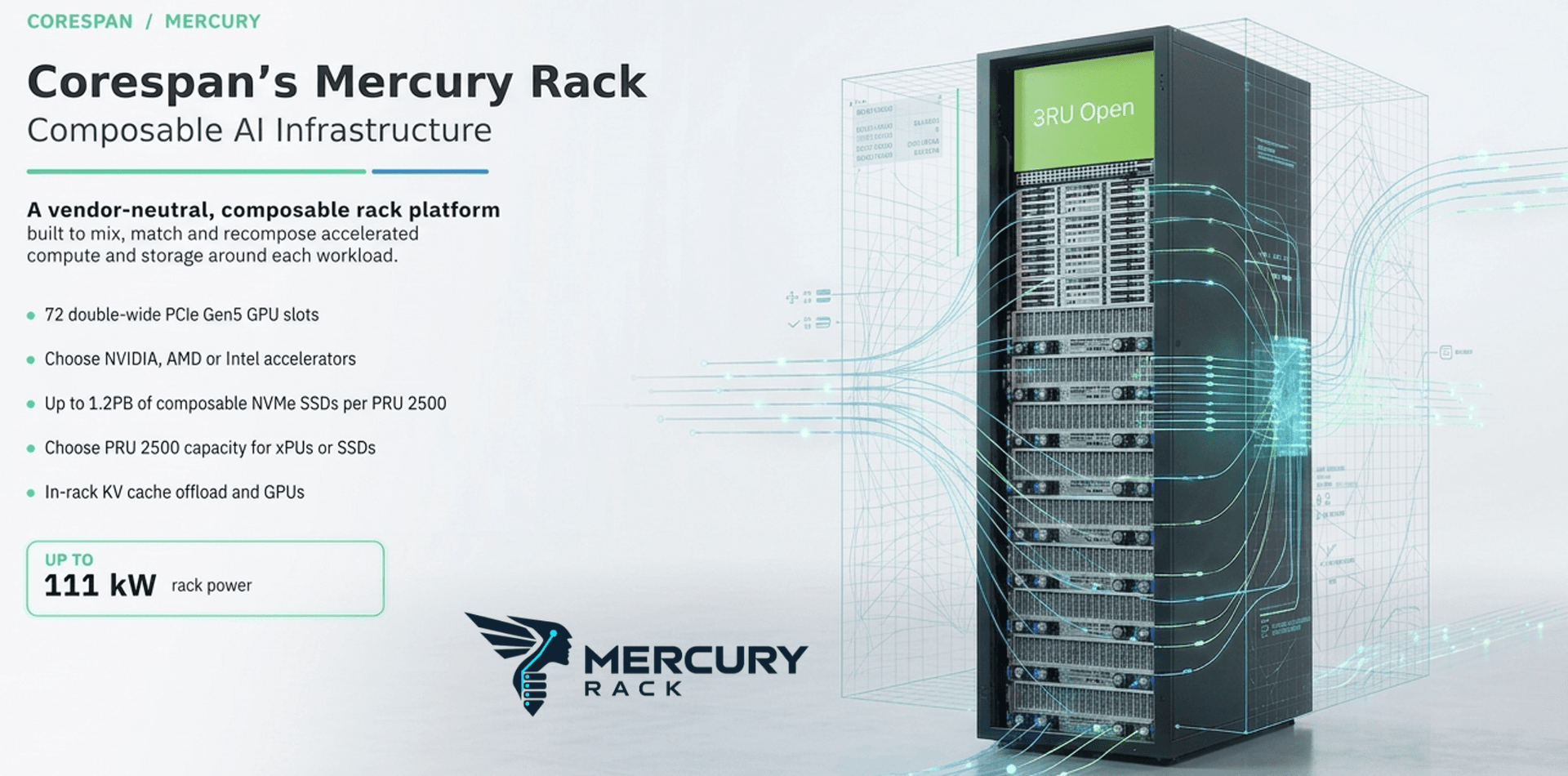
Mercury Rack: Build a Bigger Computer, Not Just a Bigger Cluster
Corespan's Mercury Rack turns pooled GPUs, xPUs, SSDs, and FPGAs into larger, right-sized computing blocks through the DynamicXcelerator architecture, native PCIe over optical, and Corespan Composer.
Read more about Mercury Rack: Build a Bigger Computer, Not Just a Bigger Cluster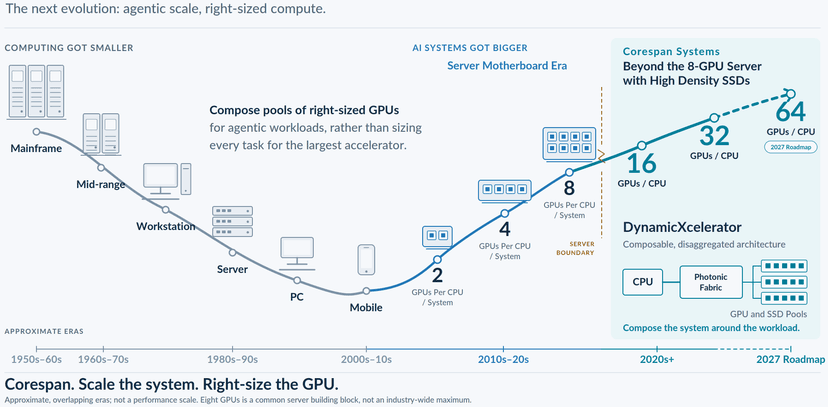
What Is Old Is New Again: The Modern Mainframe Is Composable
Time-sharing made one expensive machine serve many users. Composable infrastructure turns a shared pool into many right-sized machines — the same economics, without the fixed configuration.
Read more about What Is Old Is New Again: The Modern Mainframe Is Composable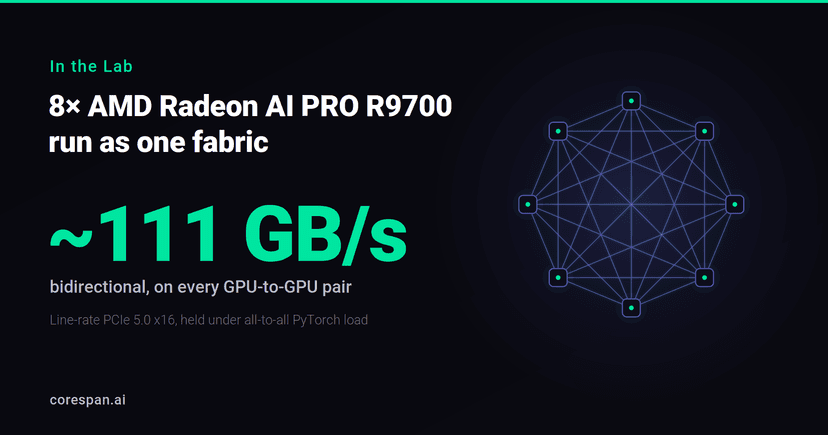
In the Lab: 8x AMD Radeon AI PRO R9700, One Fabric
We ran eight AMD Radeon AI PRO R9700s as a single fabric in a PRU 2500. Every GPU-to-GPU pair holds ~111 GB/s bidirectional — roughly 2x what NVIDIA's own reference architecture targets for RTX PRO 6000 fleets.
Read more about In the Lab: 8x AMD Radeon AI PRO R9700, One Fabric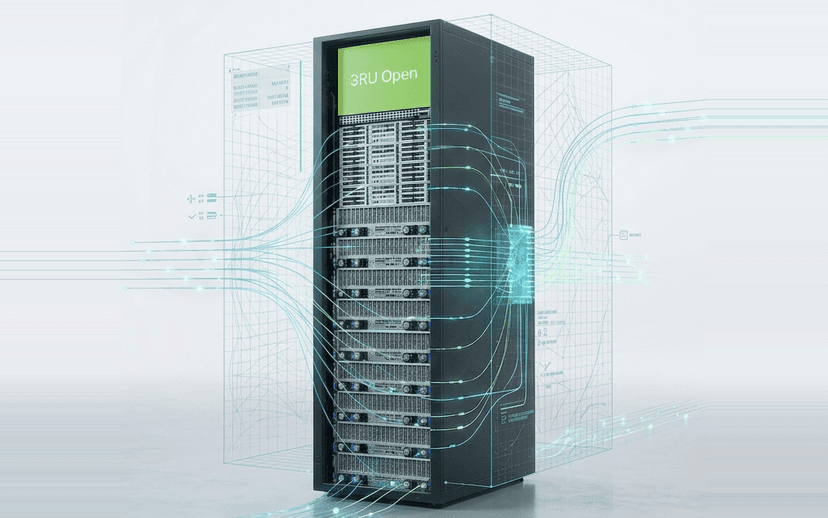
The Mercury Rack: One Rack, Every GPU, Yours to Compose
72 double-wide PCIe Gen5 slots, any vendor's accelerators, 1.2 PB of composable NVMe per PRU, and 111 kW in a standard air-cooled 48U rack. The Mercury Rack makes the compute-to-storage ratio a scheduling decision instead of a purchasing one.
Read more about The Mercury Rack: One Rack, Every GPU, Yours to Compose
Optimize Your GPU Investment. Request a Consultation
Maximize utilization, reduce stranded capacity, and align resources more closely to workload demand with photonic-native scale-across infrastructure.